
What is Acetyl Hexapeptide-8?
Acetyl Hexapeptide-8, with the INCI name Acetyl Hexapeptide-8 and the trade name Argireline, has a molecular weight of 889 Da. It is a synthetic signalling peptide consisting of six amino acid residues, with the sequence: Acetyl-Glu-Glu-Met-Gln-Arg-Arg-NH₂. The N-terminal acetylation and C-terminal amidation modifications greatly improve peptide stability and percutaneous permeation, a common structural optimisation strategy in cosmetic raw material design.
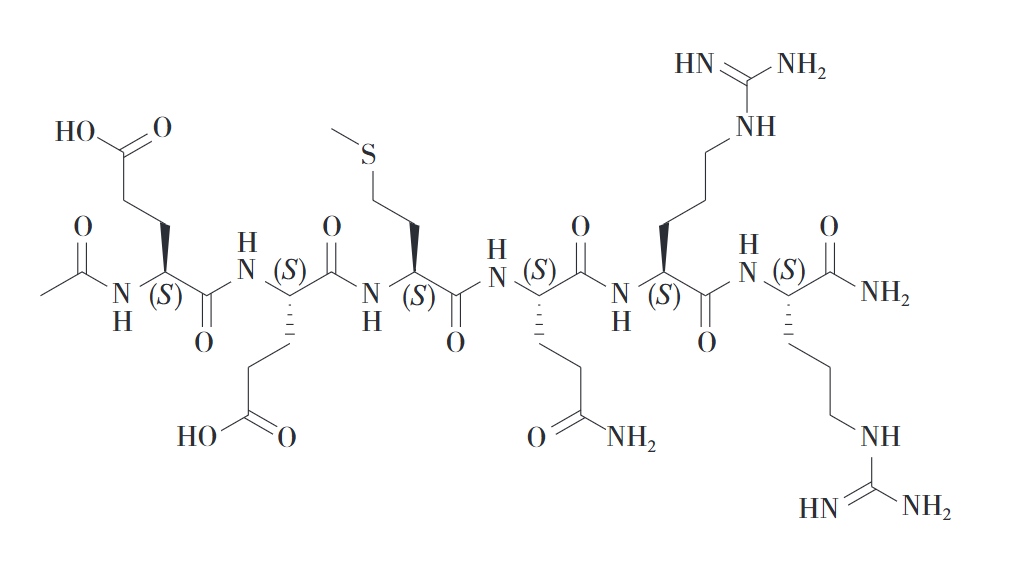
As an artificially synthesised biomimetic hexapeptide, Acetyl Hexapeptide-8 is a well-established neurotransmitter-inhibiting active peptide in cosmetics. It is registered on CosIng and in the Chinese cosmetic raw material catalogue as a skin conditioning agent and humectant.
It appears as a white to off-white powder. China has issued the industry standard Raw Materials for Cosmetics – Acetyl Hexapeptide-8 (YY/T 10004-2026), which sets unified quality control specifications for peptide content, impurities, identification methods and microbial indicators.
Mechanism of Action: Neurotransmitter Inhibition
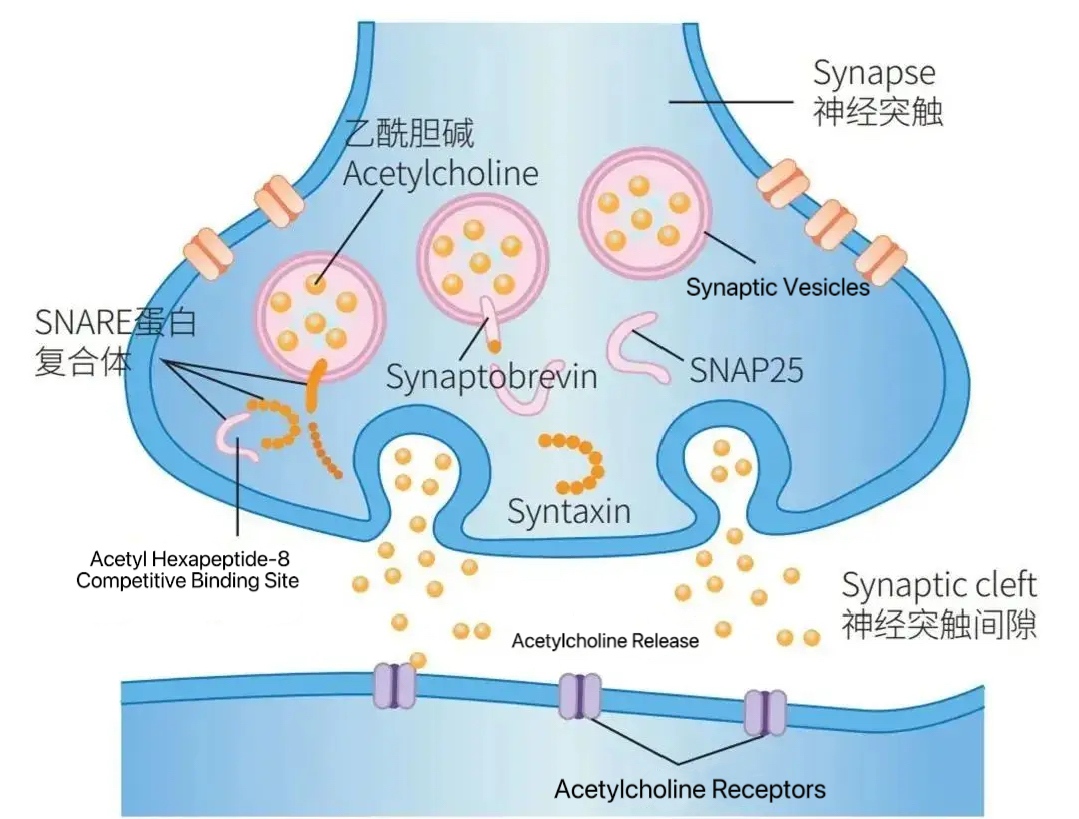
Facial dynamic wrinkles (forehead lines, crow’s feet, glabellar lines) form when acetylcholine is released from nerve endings during repeated facial expressions, triggering sustained muscle contraction. Acetylcholine release relies on the assembly of the SNARE protein complex, formed by SNAP-25, VAMP and Syntaxin, which is the core structure for synaptic vesicle fusion and neurotransmitter exocytosis.
Acetyl Hexapeptide-8 was originally inspired by the mode of action of botulinum toxin, but its pathway is entirely different. Botulinum toxin blocks neurotransmitter release by proteolytically cleaving SNARE complex proteins. Acetyl Hexapeptide-8 has no enzymatic cleavage activity. It is thought to mimic the N-terminal domain of SNAP-25 and competitively disrupt SNARE complex assembly. This gently reduces acetylcholine exocytosis from neurons, lessens excessive contraction of facial muscles, and thereby alleviates the appearance of dynamic wrinkles caused by repeated pulling of expressive muscles (such as forehead lines, crow’s feet and the upper nasolabial folds).
It should be emphasised that this effect is mild modulation rather than complete blockade, and it is reversible; the condition gradually reverts after discontinuation. This is why it is figuratively called the "topical Botox-like peptide" in the industry.
Beyond the neuromodulatory pathway, some in vitro studies suggest that Acetyl Hexapeptide-8 at suitable concentrations may help regulate the dermal matrix, support collagen maintenance and assist in improving skin firmness. However, this effect is weaker than its neuromodulatory action, and formulation claims must be cautious without overstatement.
It is also important to note its limitations: Acetyl Hexapeptide-8 is highly hydrophilic with a relatively large molecular weight, so its inherent skin penetration is limited. Formulators often optimise emulsification systems, penetration enhancers and delivery technologies to improve epidermal retention and local bioavailability, which remains a key direction for formulation research.
Efficacy Evidence: Human Trials and In Vitro Studies
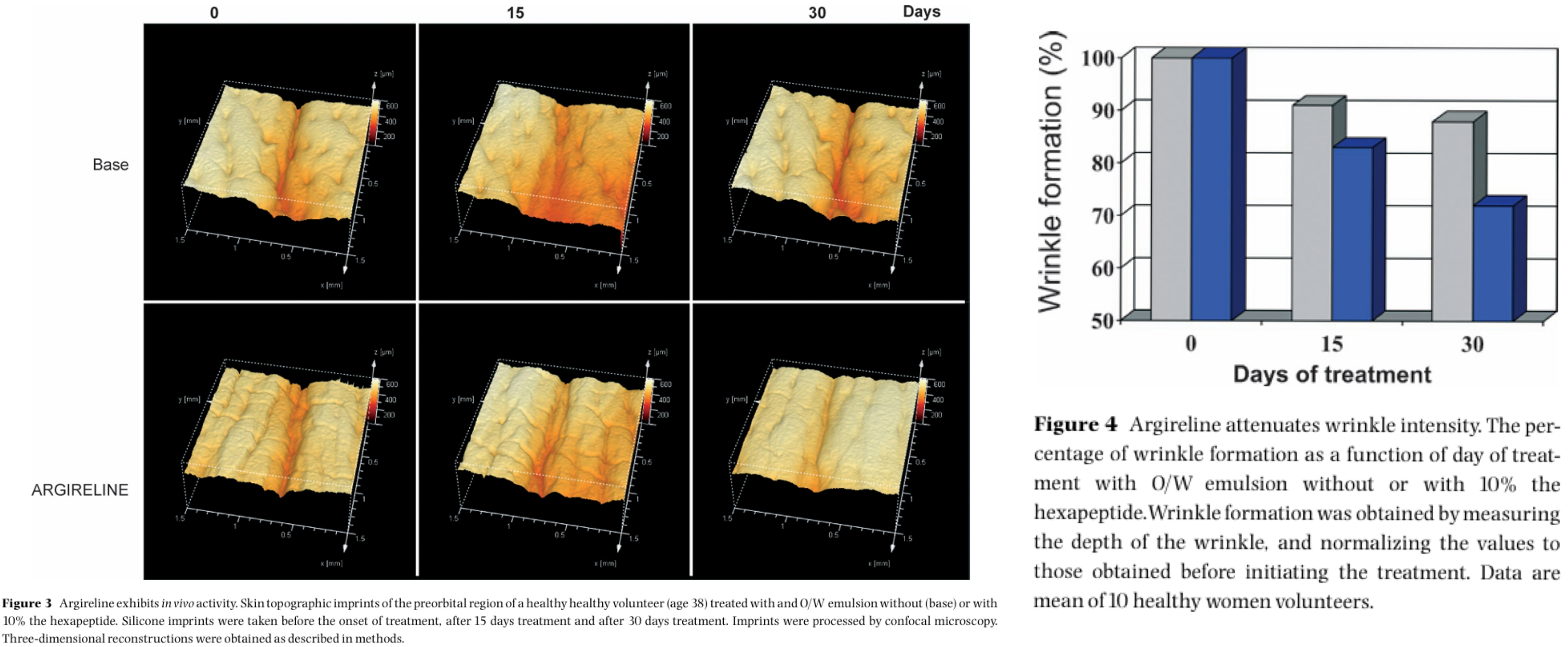
Pioneering foundational study (2002): Blanes-Mira et al. demonstrated in chromaffin cell and neuromuscular preparation models that this hexapeptide inhibits catecholamine and neurotransmitter release in a dose-dependent manner. A 10% w/o emulsion applied to the facial skin showed a trend of reduced wrinkle depth with continuous use, forming the foundational literature for mechanistic research on this raw material.
Randomised controlled human trial (2013): A placebo-controlled study on Asian subjects showed that continuous topical application of formulations containing Acetyl Hexapeptide-8 significantly reduced wrinkle depth at the outer canthus and forehead, improved skin texture, with good tolerance and no recorded serious adverse reactions. This study supported its widespread use in skincare formulations for the Asian market.
Skin permeation studies: Ex vivo human skin penetration tests indicate that, in conventional formulations, Acetyl Hexapeptide-8 mainly resides in the epidermis and rarely penetrates deep into the dermis. This characteristic makes it far less irritating than other anti-ageing ingredients such as retinoids and high-concentration acids. This is also the core reason why delivery technologies including microencapsulation and peptide penetration-enhancing systems are major R&D focuses in the industry.
Safety & Formulation Guidelines
Typical in-formula dosage: The active concentration (on neat peptide basis) is generally between 0.001%–0.005%. The US CIR safety assessment states that under normal cosmetic use and compliant dosage levels, the raw material presents low risks of genotoxicity and systemic absorption, with manageable irritation potential. Safety data at very high concentrations remains limited; formulation companies must complete their own product safety assessments and regulatory verification for filing.
✅ Suitable formulations: Leave-on skincare products including serums, eye creams, anti-wrinkle creams, sprays, lyophilised powders and facial masks. Leave-on formats are preferred; rinse-off products can barely deliver meaningful effects.
✅ Compatibility: Compatible with most humectants, polysaccharides, vitamin derivatives and other signalling peptides (Palmitoyl Tripeptides, Carnosine, etc.). The optimal pH range is neutral to weakly acidic. Strong acids, strong alkalis and prolonged high-temperature processing accelerate peptide chain hydrolysis and deactivation. Late addition and low-temperature feeding are recommended.
✅ Stability & storage: Powder raw material should be stored sealed, protected from light and kept dry under refrigeration. It remains stable when sealed at ambient temperature, though long-term storage is recommended at 2–8°C. Once prepared into liquid stock solutions, appropriate preservative and antioxidant systems should be incorporated; accelerated stability testing and content monitoring are required for shelf-life validation.
❌ Regulatory Compliance Reminder: Claims such as “botulinum toxin substitute”, “injectable alternative”, “wrinkle removal treatment” or medical therapeutic effects are prohibited. Permitted descriptive claims (per regulation) include easing the appearance of expression lines, improving the look of dynamic wrinkles, skin conditioning and firming (only when supported by literature). Filing documentation must match supporting research data.
Conclusion
Acetyl Hexapeptide-8 is one of the earliest researched and widely adopted anti-wrinkle peptide raw materials in cosmetics. Its mechanism of gently modulating neurotransmitter release to reduce dynamic wrinkles is well-supported scientifically, with corroborating evidence from human clinical studies. Thoughtful, evidence-based formulation design is critical to unlocking its performance.
Our Acetyl Hexapeptide-8 raw material is synthesised via solid-phase peptide synthesis, with strict HPLC quality control for peptide content and impurity profiles to ensure consistent batch-to-batch quality. We provide COA, MSDS, chromatograms and other supporting documents. Custom powder specifications, lab-scale samples and formulation technical support are available for efficacy skincare, eye anti-ageing and premium anti-ageing product development.
Check the product link:Acetyl Hexapeptide-8
References
[1] Blanes-Mira C, Clemente J, Jodas G, et al. A synthetic hexapeptide (Argireline) with antiwrinkle activity. International Journal of Cosmetic Science, 2002,24(5):303-310.
[2] Wang Y, Wang M, Xiao S, et al. The anti-wrinkle efficacy of argireline, a synthetic hexapeptide, in Chinese subjects: a randomized, placebo-controlled study. American Journal of Clinical Dermatology,2013,14(2):147-153.
[3] Zdrada-Nowak J, Surgiel-Gemza A, Szatkowska M. Acetyl Hexapeptide-8 in Cosmeceuticals—A Review of Skin Permeability and Efficacy. International Journal of Molecular Sciences, 2025,26(12):5722.
[4] Kraeling M E, Zhou W, Wang P, et al. In vitro skin penetration of acetyl hexapeptide-8 from a cosmetic formulation. Journal of Cosmetic Dermatology,2014,13(2):114-120.
[5] 国家药监局. YY/T 10004-2026 化妆品用原料 乙酰基六肽 - 8 [S].2026.
[6] Cosmetic Ingredient Review (CIR). Safety assessment of acetyl hexapeptide-8 and related peptides as used in cosmetics(相关安全性评估资料)