
Basic Knowledge: What Are IECIC and CosIng?
One-sentence distinction: IECIC is China’s inventory for cosmetic ingredients, while CosIng is the EU cosmetic ingredient information database.
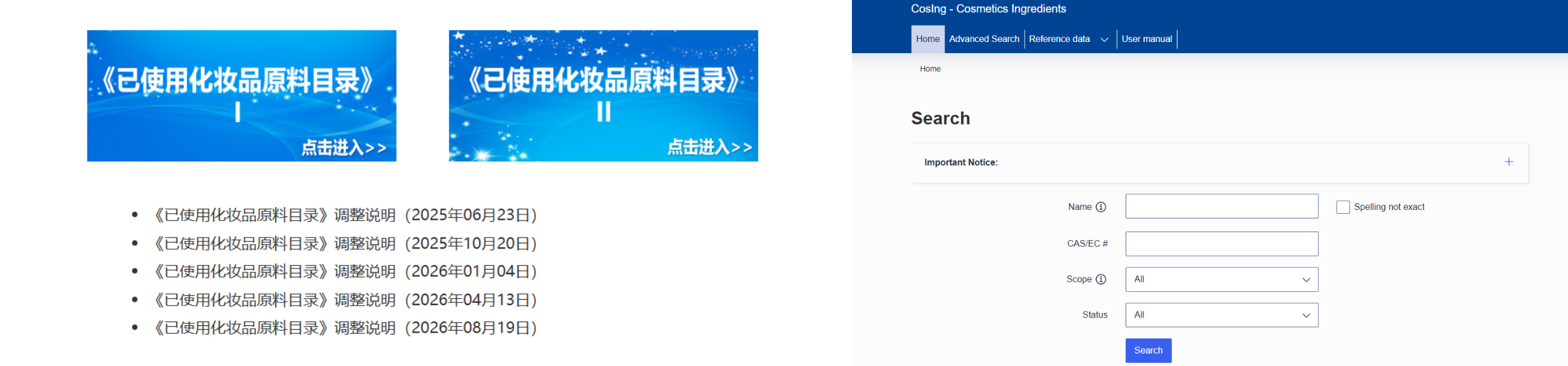
IECIC (Inventory of Existing Cosmetic Ingredients in China)
Maintained by the National Medical Products Administration (NMPA), it can be regarded as the "roster" of cosmetic ingredients in China.
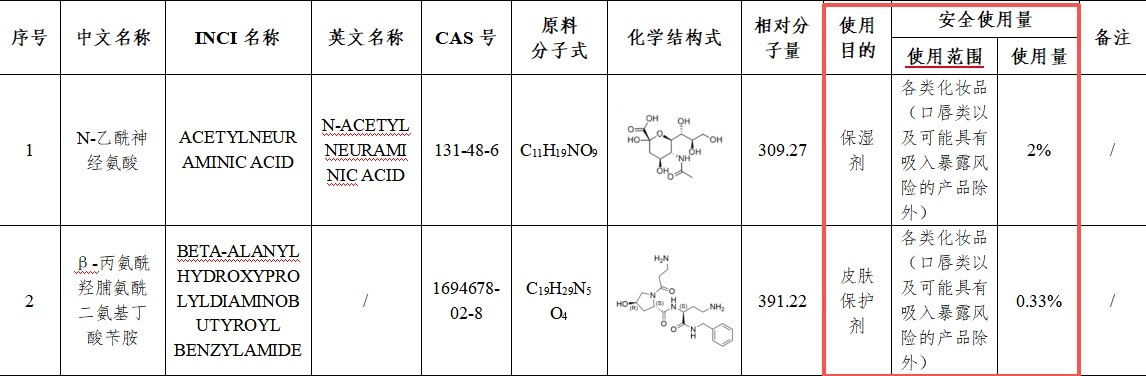
If an ingredient is listed in the inventory: it counts as an existing cosmetic ingredient and may be directly used in cosmetic formulations once relevant safety requirements are met.
If no matching result is returned: the substance is by default classified as a new cosmetic ingredient and cannot be put into production directly. It must undergo safety assessment and filing procedures for new cosmetic ingredients.
⚠️ Common Pitfall: Inclusion in IECIC does not mean unlimited usage. The inventory only proves the ingredient has a history of cosmetic application. Many ingredients carry restrictions on maximum concentration, application sites and eligible product categories. Listing status alone does not permit arbitrary addition. Some cosmetic ingredients shall be used in compliance with the Technical Specifications for Cosmetic Safety.
CosIng (EU Cosmetic Ingredient Database)
A public lookup platform built by the European Commission to support EU Cosmetic Regulation (EC) No 1223/2009. It records INCI names, basic chemical information and ingredient functions, and marks provisions for prohibited and restricted substances.
Status: Active refers to currently valid entries; Not active refers to archived historical entries, which generally shall not serve as the basis for current compliance judgment.
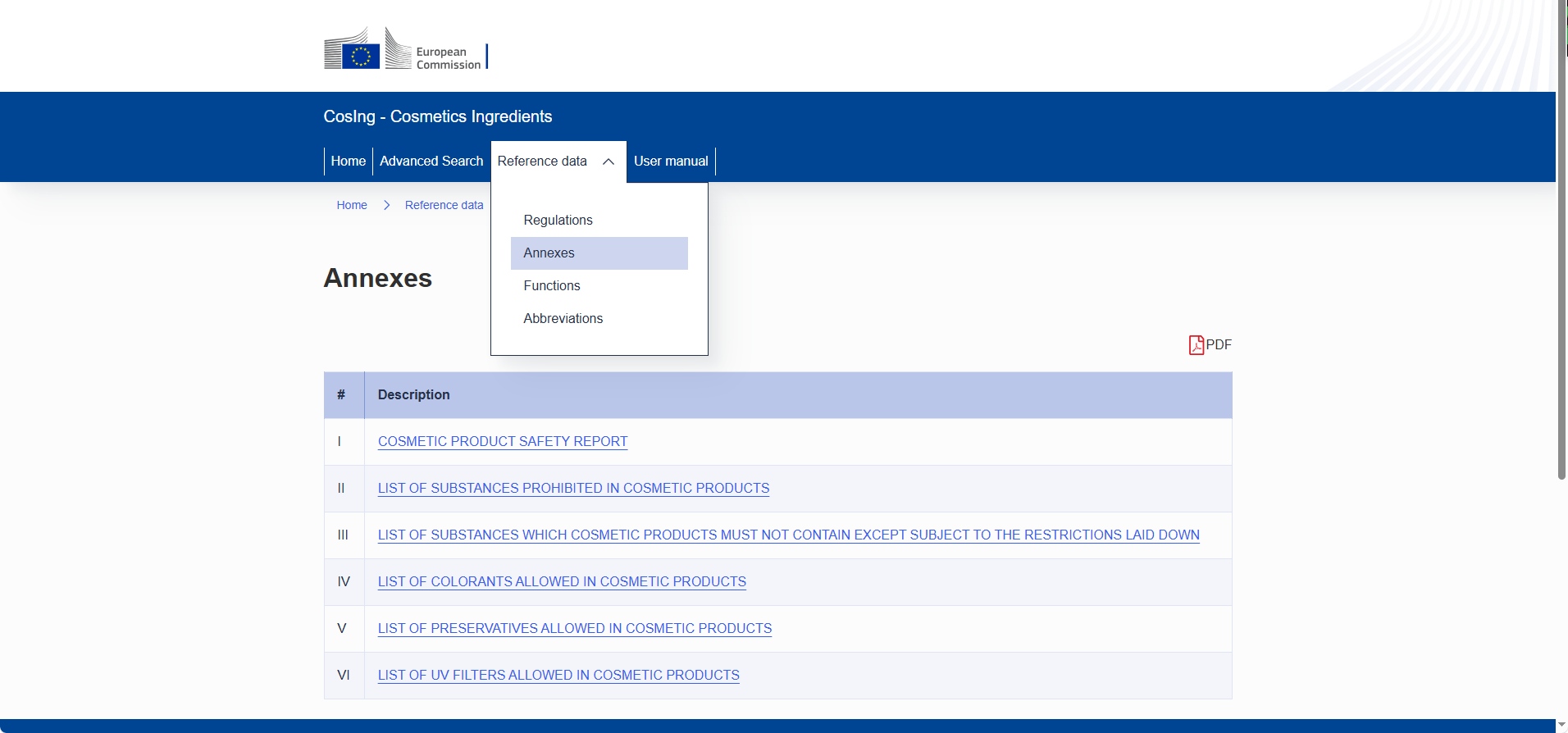
Key Annex Classification: Annex II covers prohibited substances, which must not be added; Annex III covers restricted substances whose use must strictly follow concentration limits and application scenarios. There are also dedicated categories for colorants, preservatives and UV filters.
⚠️ Important Reminder: CosIng is essentially an information retrieval database and carries no legal force. Final compliance judgment of ingredients shall be subject to the original EU regulatory texts. Many practitioners mistakenly believe that retrievable entries in CosIng mean approval for use in the EU. Note that some substances are searchable but listed in prohibited annexes.
Hands-on Practice: How to Search for Ingredients
✅ Look up China IECIC
Prepare INCI name and CAS number for search. Avoid using Chinese names alone, as homonymous substances are widespread in the raw material industry.
Access the official IECIC query portal of NMPA: https://hzpsys.nidc.org.cn/hzpGS/ysyhzpylml#
After retrieval, verify the chemical definition and number of the ingredient, and distinguish between List I and List II.
If matched: check whether the ingredient has usage restrictions. If no match: treat it as a new cosmetic ingredient.
Save screenshots of search results and file them in internal formulation records.
Practical tip: One ingredient may have multiple aliases. Cross-search with different names to avoid missing records.
✅ Look up EU CosIng
Visit the official CosIng website: https://ec.europa.eu/growth/tools-databases/cosing/. It supports basic and advanced search modes.
Recommended search terms: INCI name, CAS number, EC number. Cross-verification with CAS numbers delivers more reliable results.
Filter for entries with
Activestatus and exclude archived historical records.Focus on verifying: relevant annex, maximum permitted concentration, eligible product types and warning label requirements.
Save page records for subsequent audits and formulation filing.
Frequent Industry Misconceptions Encountered by R&D Teams
Misconception 1: An ingredient found in IECIC can be added without limits
✅ Clarification: Listing only indicates prior usage history. Concentration limits and applicable scope require separate verification.
Misconception 2: An ingredient retrievable in CosIng can be safely used in the EU
✅ Clarification: Always check the corresponding annex. Some searchable substances fall under EU prohibited categories.
Misconception 3: Searching only by Chinese name is sufficient
✅ Clarification: Homonymous substances are common. Dual search using INCI + CAS is the standard and reliable industry practice.
Misconception 4: Search results remain permanently valid after a one-time lookup
✅ Clarification: Both databases are dynamically updated. Regular regulatory reviews are required for long-term projects.
Misconception 5: Directly reuse INCI names from CosIng for domestic filing
✅ Clarification: INCI names for domestic filing shall follow the nomenclature recorded in IECIC. Naming discrepancies exist between the two regions.
Summary
IECIC and CosIng are free and practical preliminary screening tools at the ingredient selection stage. Developing the habit of "checking inventories first" helps screen out obviously non-compliant ingredients in advance and reduce rework in later stages.
Check our cosmetic ingredient catalog: https://wanlvcn.com/products