
First, understand what HAP and CaHA actually stand for
HAP (Hydroxyapatite)
HAP is the general abbreviation for hydroxyapatite as a broad material family. It only defines the crystal composition and sets no restrictions on morphology, particle size or application.
The HAP family covers a wide range of forms: nano acicular powder, nanospheres, irregular micron powder, porous hydroxyapatite ceramic blocks and bone repair granules. Nano‑hydroxyapatite (nano‑HAP), commonly used in skincare and toothpaste, is the most mainstream branch within the HAP family.
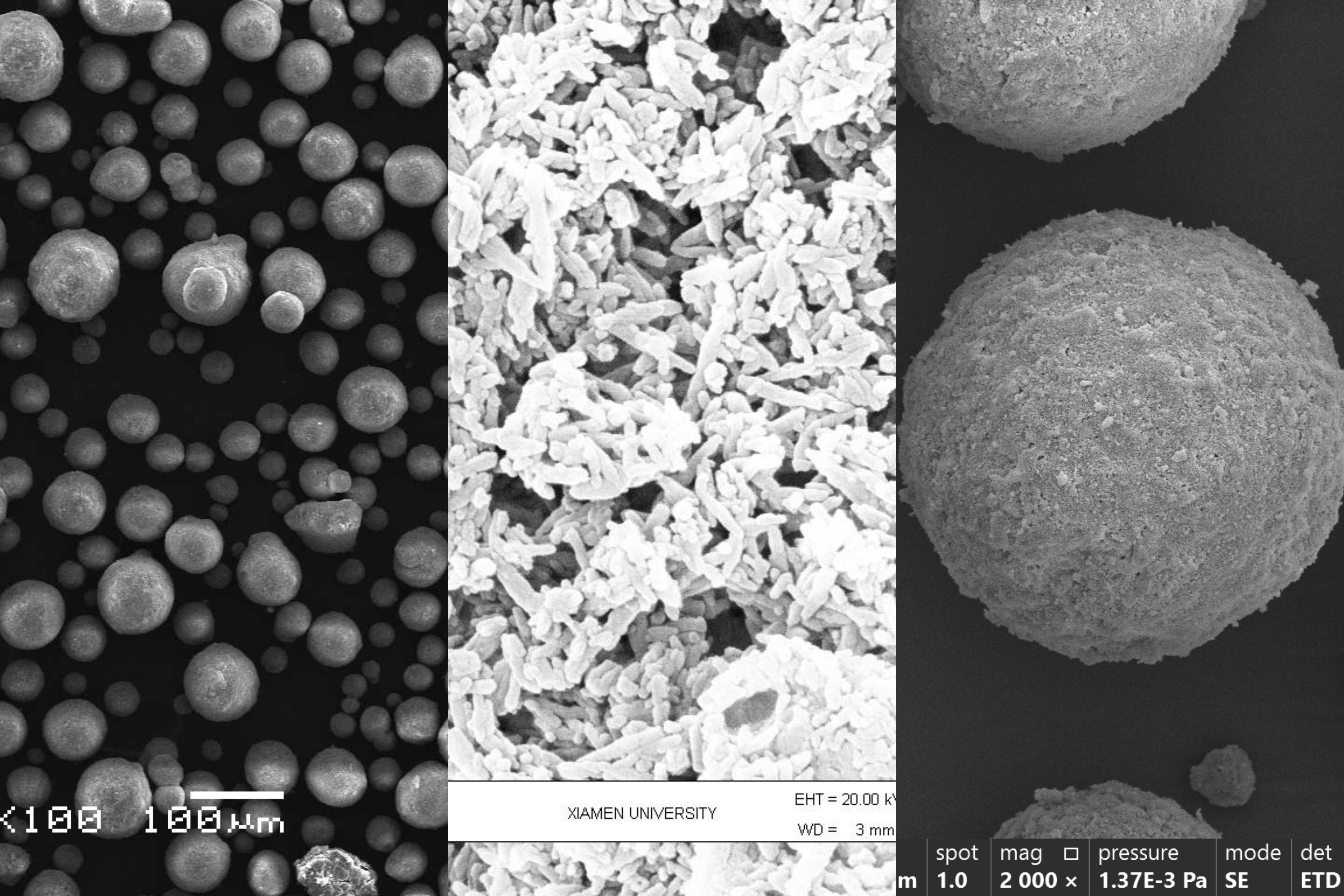
SEM micrographs of HAP morphologies (spherical, acicular, mesoporous spherical from left to right)
CaHA (Calcium Hydroxyapatite)
CaHA refers to highly dense sintered hydroxyapatite microspheres with high sphericity and a tightly controlled particle size range of 25–45 μm.
By industry convention in regenerative aesthetic medicine, it represents a specially formulated biostimulatory system: CaHA microspheres dispersed in a CMC (carboxymethyl cellulose) gel carrier, supplied as a pre‑filled injectable suspension classified as a Class III medical device in China.
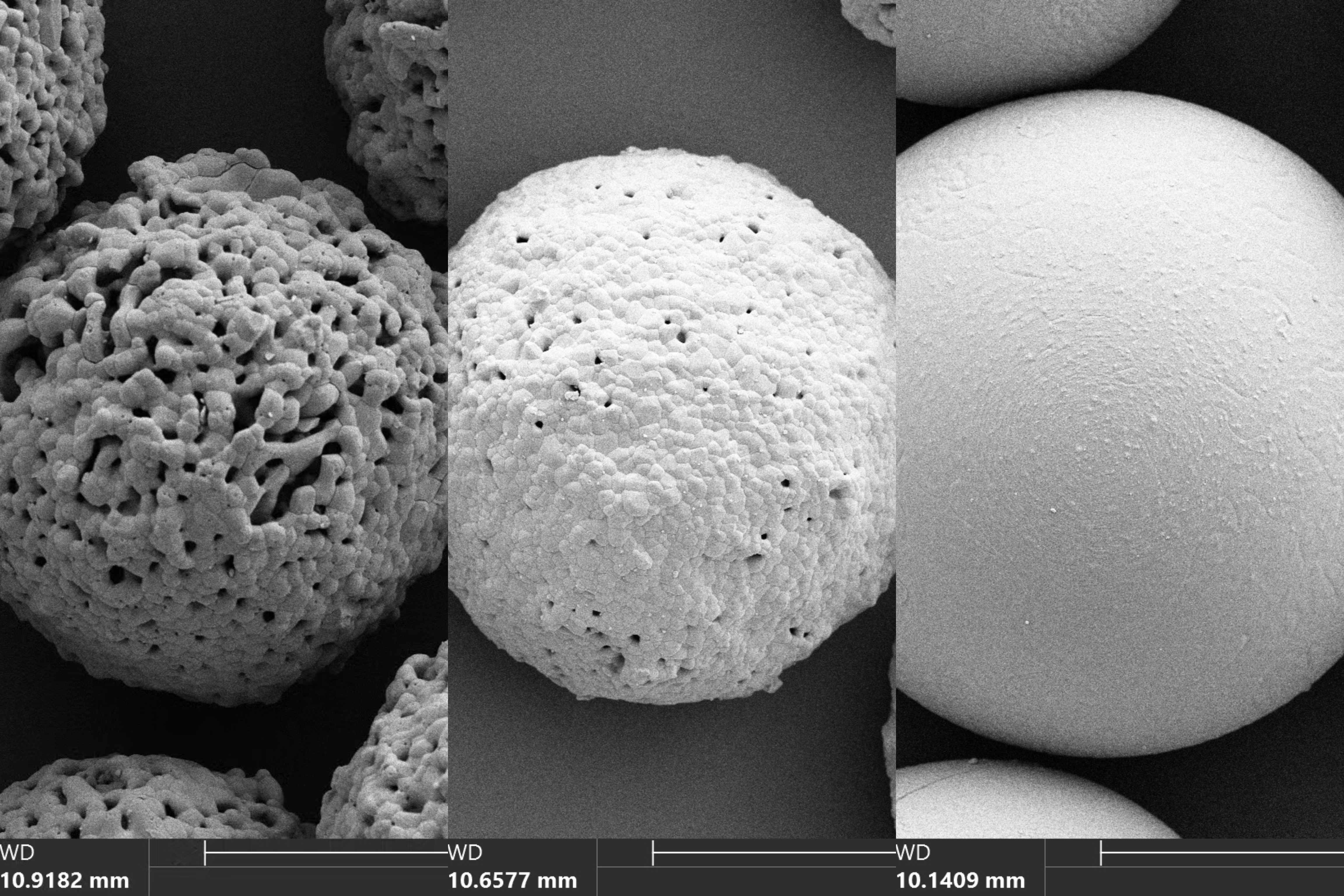
SEM micrographs of CaHA morphologies (porous, microporous, solid spherical from left to right)
In short: CaHA used for aesthetic injections is chemically a type of HAP, yet the vast majority of HAP powders on the market are not the CaHA intended for clinical aesthetic injection.
Core Comparison: HAP vs. Injectable-Grade CaHA
Comparison Item | General HAP | Injectable-Grade CaHA for Aesthetics |
|---|---|---|
Microscopic Morphology | Acicular, flocculent, granular, irregular crystallites, small nanospheres | Highly spherical, smooth-surfaced microspheres |
Typical Particle Size | 20–100 nm, 4.5 μm, etc. | 25–45 μm |
Product Form | White powder | White powder (formulated into injectable suspension for finished devices) |
Mechanism of Action | Topical use: relies on adsorption to support enamel remineralization and assist skin barrier repair. Porous HAP fabricated as bone scaffolds achieves bone ingrowth via osteoconduction. | Spherical microspheres stimulate fibroblasts through mechanical signals to induce type I and type III collagen synthesis, functioning as a biostimulatory filler. |
Regulatory Classification | Registered and tested according to its application, as a cosmetic raw material or bioceramic for orthopedics | Regulated as a Class III medical device in China |
Main Application Scenarios | Toothpaste, enamel repair products, barrier-repair serums, calcium supplement materials, bone tissue engineering scaffolds | Deep dermal injection, facial contouring, collagen biostimulation |
Three Common Industry Misconceptions
Misconception 1: Same chemical formula means interchangeable efficacy
Identical composition does not guarantee identical biological behavior on or inside the human body.
HAP features an extremely high specific surface area and strong adsorption capacity, making it suitable for binding to enamel and adsorbing pigments and irritants. Once these angular particles are injected subcutaneously, however, they cause persistent tissue irritation and foreign-body inflammation.
Aesthetic-grade CaHA microspheres are manufactured with spheronization, high-temperature dense sintering and narrow particle-size screening. These processes are designed specifically to reduce foreign-body irritation and achieve predictable degradation and stable collagen stimulation — outcomes that regular HAP powder cannot deliver.
Misconception 2: CaHA is premium HAP, while HAP is low-grade CaHA
They are two independently developed material systems with fundamentally different design objectives; there is no hierarchical relationship.
HAP is engineered for topical remineralization and soothing skin repair.
The CaHA microsphere system is developed for deep subcutaneous injection and soft tissue regeneration. Marketing HAP as injectable CaHA counts as off-label claim and carries compliance risks.
Misconception 3: They share identical degradation rates and metabolic pathways
The degradation rate of HAP powder is governed by crystallinity, specific surface area and crystal defects.
HAP has a large specific surface area and degrades faster.
Highly crystalline, dense spherical CaHA microspheres degrade slowly in vivo, releasing calcium and phosphate ions that participate in normal calcium-phosphorus metabolism with a controllable degradation cycle.
IV. Selection Guide: How to Choose for Different Applications
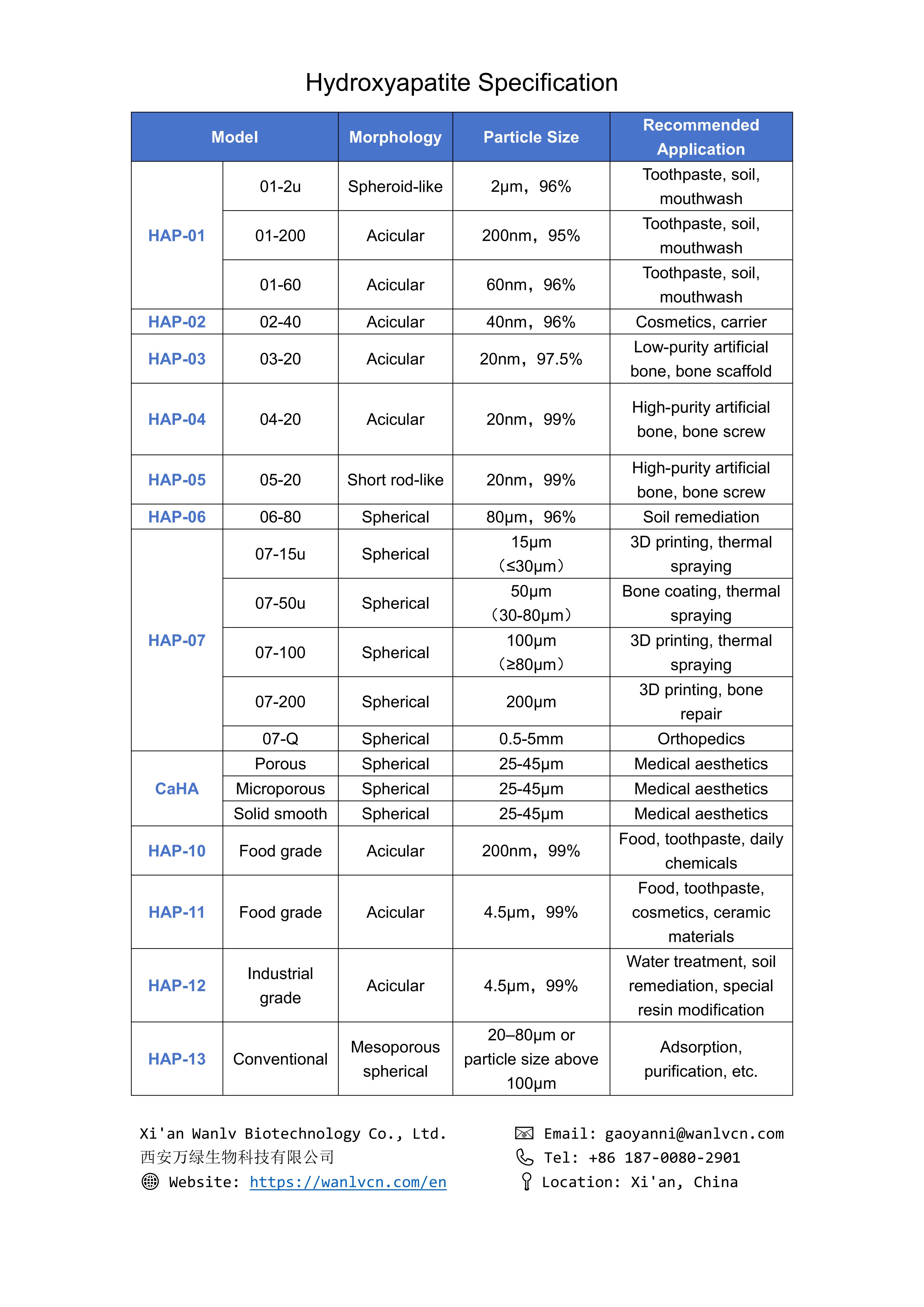
✅ The applicable scenarios corresponding to different hydroxyapatite grades and specifications are shown in the figure below:
Closing Remarks
When selecting raw materials, do not judge merely by the name “hydroxyapatite” or get confused by abbreviations. During procurement and formulation development, evaluate materials comprehensively based on morphology, particle size, product form and administration route. HAP represents an extensive material family, and CaHA is only a specialized finished product defined for aesthetic injection. Clarifying this boundary helps guarantee consistent product performance while upholding compliance and safety standards for raw material use.
Check the product link:HAP (Hydroxyapatite) Cosmetic Ingredient | WanlvCaHA(Calcium‑Hydroxylapatite)
Reference
1. Lorenc ZP, Bass LM, Fitzgerald R, et al. Physiochemical characteristics of calcium hydroxylapatite. Pan-Asian Consensus on Calcium Hydroxyapatite for Skin Biostimulation, Contouring, and Combination Treatments. J Cosmet Dermatol. 2021.
2. Wang V, Rohrich RJ. Calcium Hydroxylapatite: Over a Decade of Clinical Experience. Plast Reconstr Surg Glob Open. 2017.