
【Popular Science Disclaimer】This article is an ingredient science popularization content, sourced from public academic research literature. It is only for industry knowledge sharing and does not constitute a product efficacy commitment. The actual efficacy of cosmetics shall be subject to the filing information, and this content does not replace medical diagnosis and treatment.
Two Major Application Fields of Hydroxyapatite: Biomedicine and Industrial Materials
I. Biomedical Field
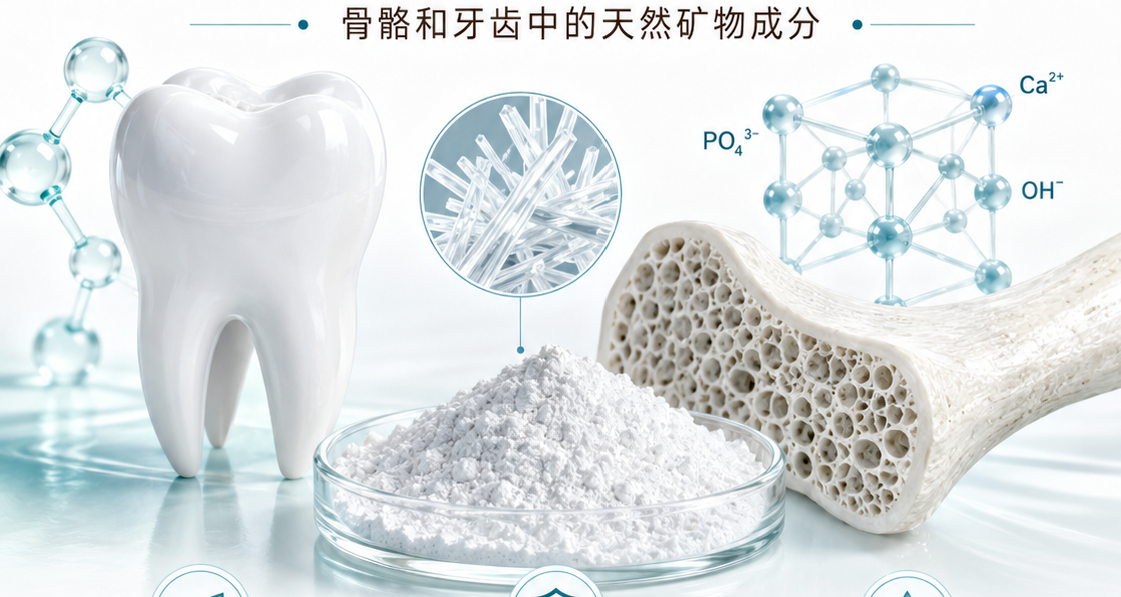
Orthopedic Repair and Implantation: As the main inorganic component of human bone, hydroxyapatite can form a tight bond with bone tissue. Its porous structure provides a growth scaffold for autologous bone cells, addressing the pain points of insufficient donor sources in traditional autologous bone transplantation and immune rejection of allogeneic bone. It is also widely used as a surface bioactive coating for artificial joints and spinal internal fixation devices, which significantly enhances the bonding strength between the implant and autologous bone, and reduces the probability of postoperative implant loosening.
Dental Care and Restoration: Hydroxyapatite is one of the core ingredients of current functional toothpastes. In clinical dentistry, it is also applied to the surface coating of dental implants, alveolar bone defect filling, and periodontal tissue regeneration guided membranes, to improve the long-term survival rate of dental implants.
Aesthetic Filling: Calcium hydroxylapatite (CaHA) was approved by the U.S. FDA in 2006 for skin filling to improve moderate to severe facial wrinkles and volume loss. Prior to that, CaHA obtained the European CE certification in 2002 and was used for vocal cord injection laryngoplasty. In 2003, Radiesse was approved for facial filling in Europe.
Drug Sustained-release Carrier: Nano-hydroxyapatite with a porous structure can efficiently load antibiotics and anti-tumor drugs, precisely deliver drugs to the lesion site, achieve controlled release for up to several weeks, and greatly reduce the toxic and side effects of systemic medication. It has been clinically applied in scenarios such as local chemotherapy after osteomyelitis and bone tumor surgery.
II. Industrial and Environmental Protection Field
Relying on its unique ion exchange and adsorption properties, hydroxyapatite also demonstrates extremely high application value in environmental protection and special industrial scenarios:
Water Treatment and Purification: Through ion exchange, it can efficiently adsorb harmful ions such as lead, cadmium and fluorine in water. With large adsorption capacity and no secondary pollution, it is currently a popular adsorbent for advanced industrial wastewater treatment and drinking water defluoridation.
Soil Pollution Remediation: Modified hydroxyapatite can degrade persistent organic pollutants such as polycyclic aromatic hydrocarbons in soil through catalysis, while immobilizing heavy metal ions in soil to prevent them from entering crops and groundwater. It is one of the core functional materials for farmland soil remediation.
Special Functional Materials: The inorganic fire-resistant paper prepared from ultralong hydroxyapatite nanowires features high flexibility, high temperature resistance and non-combustibility. It also has excellent adsorption capacity for PM2.5 fine particulate matter and organic pollutants, and can be used in special scenarios such as permanent preservation of important archives and air purification filter elements.
In addition to the above application fields, researchers can develop dedicated hydroxyapatite products adapted to different segmented scenarios by precisely regulating parameters such as particle size, morphology, porosity and surface charge. With its excellent biocompatibility, favorable osteoconductivity and outstanding ion exchange capacity, hydroxyapatite will definitely play a greater role in the fields of biomedicine, environmental functions, chemistry and industrial catalysis as technology advances.