
Raw Material Profile
N‑Acetylneuraminic acid (Neu5Ac, commonly known as bird’s nest sialic acid) has the molecular formula \(\boldsymbol{C_{11}H_{19}NO_9}\) and a molecular weight of 309.27. It is a 9‑carbon amino monosaccharide, appearing as white powder and readily soluble in water. As a core terminal monosaccharide component of glycoprotein and glycolipid glycans, it widely exists on human cell membranes, breast milk, animal tissues and edible bird’s nests.
Raw N‑acetylneuraminic acid extracted from traditional edible bird’s nests suffers from high production costs and limited output. Industrial-grade products are mainly produced via microbial fermentation: using glucose and corn steep liquor as substrates, engineered strains perform fermentation followed by purification. This route delivers high purity and sustainable green manufacturing, and it is the mainstream supply form for food and cosmetic industries.
N‑acetylneuraminic acid is a raw material applicable for both food and cosmetic use. It has obtained qualifications as a novel food ingredient and cosmetic new ingredient in China respectively. It is the first domestically innovative cosmetic new ingredient filed and included in the Inventory of Used Cosmetic Ingredients.
Mechanism of Action
Mechanism for Food Applications
Supports nervous system development and benefits cognition As a key building block of gangliosides and brain glycoproteins, Neu5Ac is enriched in cerebral gray matter. It participates in the proliferation, differentiation and synapse formation of neurons, facilitating nerve signal transmission. Exogenous supplementation can elevate cerebral ganglioside levels, exerting positive effects on early brain development in infants and maintaining cognitive function and memory in adults and the elderly.
Modulates immunity and epithelial barrier; competes against pathogen adhesion Many bacteria and viruses rely on binding to sialic acid sites on cell surfaces to adhere and invade host cells. N‑acetylneuraminic acid acts as a competitive receptor: it binds to surface proteins of pathogens, reducing pathogen attachment to respiratory and intestinal epithelial cells and lowering infection risks. Meanwhile, it regulates immune cell adhesion and cytokine release to exert anti‑inflammatory effects and maintain mucosal immune barrier integrity.
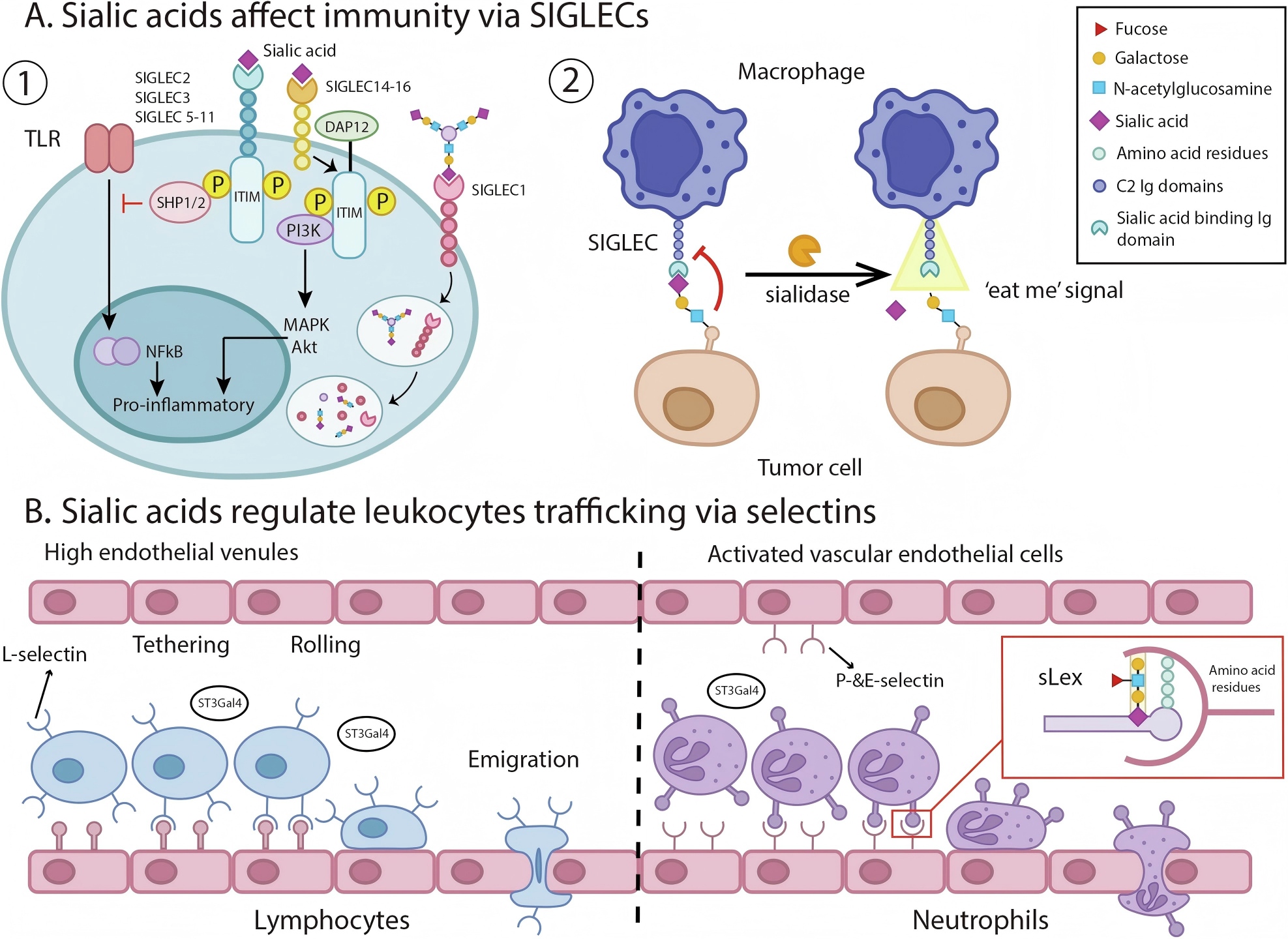
(A:Modulation of Immune Responses by SIGLECs;B:Leukocyte Trafficking Facilitated by Sialic Acid. SIGLECs sialic acid-binding immunoglobulin-like lectins, SHP Small Heterodimer Partner, ITIM immunoreceptor tyrosine-based inhibition motif, TLR toll-like receptor, DAP12 DNAX activation protein 12, SLex sialyl-Lewis X, PI3K phosphoinositide-3 kinase.)
Antioxidation and promotion of nutrient absorption in gut It scavenges reactive oxygen species and alleviates oxidative stress damage. It also boosts intestinal absorption of minerals, vitamins and other nutrients and stabilizes intestinal microecology.
Mechanism for Cosmetic Applications
Skin barrier repair and moisturization It stimulates synthesis of macromolecules such as glycoproteins and hyaluronic acid in the stratum corneum, reinforces the lipid‑glycoprotein network of keratinocytes, reduces transepidermal water loss, improves skin water retention and repairs damaged skin barrier.
Antioxidation, anti‑wrinkle and anti‑aging effects It captures free radicals and mitigates oxidative damage induced by UV exposure and environmental irritants. It optimizes the dermal matrix microenvironment, helps sustain collagen homeostasis and diminishes fine lines for anti‑aging and anti‑wrinkle benefits.
Inhibition of melanin production It suppresses tyrosinase activity and reduces melanin synthesis and transfer in melanocytes. Skin brightening potential has been observed in 3D human skin model tests, delivering skin tone conditioning effects.
Disclaimer: The efficacy descriptions above are based on published literature. Product claims must strictly comply with domestic advertising and cosmetic labeling regulations; medical efficacy claims are prohibited.
Applications and Domestic Regulatory Requirements
Food Sector
Regulatory Basis: Announcement No.7 of 2017 released by National Health Commission of the People’s Republic of China. N‑acetylneuraminic acid is approved as a novel food ingredient.
Manufacturing process: Fermentation using food‑grade glucose and corn steep liquor by Escherichia coli, followed by filtration, sterilization, hydrolysis and purification.
Scope of application: Infant formula food, beverages, milk beverages, candies and baked foods; excluding food for pregnant women and lactating women.
Usage limits: ≤100 mg/L for infant formula food; for other foods, dosage at the discretion of manufacturers in accordance with production needs.
Label requirements: The ingredient name N‑acetylneuraminic acid shall be marked on product labels, alongside warnings for unsuitable populations.
International status: N‑acetylneuraminic acid has obtained GRAS status from the US FDA and is permitted for use in infant formula. It is also approved as a novel food ingredient in the EU.
Cosmetic Sector
INCI Name: ACETYLNEURAMINIC ACID
Filing timeline: China’s first cosmetic new ingredient filing (National Cosmetic New Ingredient Filing No. 20210001). After completing the 3‑year safety monitoring period in June 2025, it was incorporated into Inventory of Used Cosmetic Ingredients (Part Ⅱ) for regular application.
Safe usage limit: Maximum addition level 2% for all cosmetic products, except lip products and products with inhalation exposure risks, where addition is not recommended.
Permitted efficacy claims: Moisturizing, skin protection, antioxidation, anti‑wrinkle.
Compliance reminder: Safety assessment must be completed for formulation application. Efficacy claims of finished cosmetics must be supported by corresponding efficacy test evidence; medical efficacy claims are forbidden.
Applicable product categories: Serums, creams, masks, toners, lotions and other leave‑on skincare products.
Application Scenarios
Food: Infant formula milk powder, functional solid beverages, compressed candies, dairy drinks and baked goods.
Cosmetics: Anti‑aging serums, barrier repair creams, moisturizing masks and soothing skincare products.
References
[1] National Health Commission of the People’s Republic of China. Announcement on 10 Novel Food Ingredients Including Shea Butter (No.7 of 2017)[EB/OL]. https://www.nhc.gov.cn/zwgk/jdjd/201706/92a25591161546e3914ebc02cb52b11b.shtml
[2] National Medical Products Administration of the People’s Republic of China. Announcement of NMPA on Matters Concerning the Administration of the Inventory of Used Cosmetic Ingredients (No.61 of 2025)[EB/OL]. https://www.nmpa.gov.cn/directory/web/nmpa/hzhp/hzhpjg/hzhptg/hzhptg/202506/t20250624153604121.html
[3] Li Y, Chen X. Sialic acid metabolism and sialyltransferases: natural functions and applications[J]. Applied Microbiology and Biotechnology, 2012,94:887–905. https://doi:10.1007/s00253-012-4040-1
[4] Liu C, Lv X, Li J, et al. Metabolic engineering of Escherichia coli for increased bioproduction of N-Acetylneuraminic acid[J]. Journal of Agricultural and Food Chemistry,2022,70:15859–15868. https://doi:10.1021/acs.jafc.2c05994
[5] Zhao H, Li X L, Zhou S H, et al. Research status of N-acetylneuraminic acid[J]. Food Industry,2022,43(6):254-258.