
Overview of Vitamin A Derivatives
Since tretinoin can directly bind to receptors and has the highest activity, it is prohibited from being added in cosmetics. Therefore, the vitamin A family has derived a group of fat-soluble ingredients with similar biological activities, whose activity and transformation relationship is: Retinol → Retinal → Tretinoin (active form).
Retinol needs to undergo two-step enzymatic transformation in the skin to generate tretinoin before exerting biological effects; retinal only requires one-step transformation; retinyl esters (retinyl palmitate, retinyl acetate) have a longer transformation path, weaker activity, but significantly better raw material stability than free retinol, and are often used as mild alternative raw materials.
Ingredient | Chemical Form | Transformation Steps | Biological Activity | Irritation |
|---|---|---|---|---|
Tretinoin (Tretinoin) | Carboxylic acid | 0 steps | Highest | Strongest |
Retinal | Aldehyde | 1 step | High | Relatively strong |
Retinol | Alcohol | 2 steps | Moderate | Moderate |
Retinyl Ester | Ester | 3 steps | Relatively low | Relatively low |
Hydroxypinacolone Retinoate (HPR) | Ester derivative | Directly binds to receptors | High | Low |
Raw Material Basic Information and Process
Retinol (C₂₀H₃₀O, molecular weight 286.45, CAS No. 68-26-8) is a fat-soluble yellow crystalline powder. Its molecular structure contains a β-ionone ring and a long-chain unsaturated conjugated side chain. The conjugated double bond system in its molecular structure determines its high sensitivity to light, heat and oxygen. It needs to be stored away from light, filled with nitrogen and at low temperature.
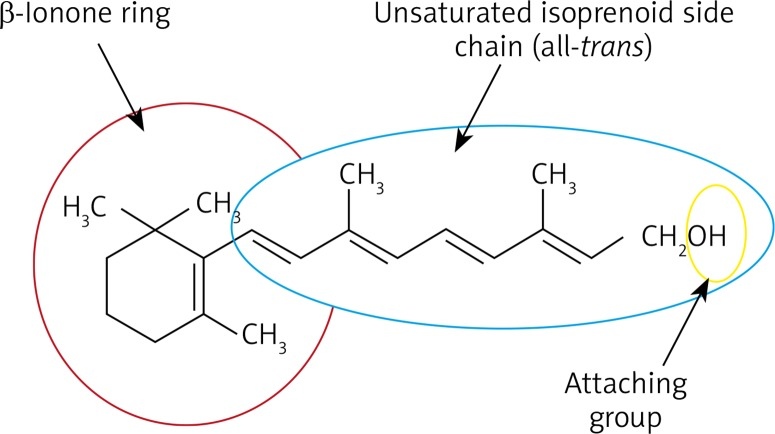
At present, cosmetic-grade retinol is mainly obtained through chemical synthesis, and the mainstream processes include:
Roche process: Using β-ionone as the starting material, synthesized via the C₁₅+C₅ condensation route;
BASF process: An improved Wittig reaction route.
The raw material forms derived from retinol include: retinol crystal powder (≥98%), retinal crystal powder (≥98%), retinol oil solution (50%), pre-stabilized encapsulated retinol (liposome, cyclodextrin inclusion complex, etc.). Different raw material forms directly determine the optional system, storage shelf life and final efficacy of the formula.
Retinol Mechanism of Action
Metabolic Transformation Path
After retinol enters the skin, it needs to undergo two-step oxidation to be transformed into the active form retinoic acid:
Retinol → Retinal → Retinoic Acid
This transformation is catalyzed by alcohol dehydrogenase (ADH) and aldehyde dehydrogenase (RALDH). Retinoic acid then binds to nuclear retinoic acid receptors (RAR/RXR) to regulate target gene transcription and achieve skin remodeling effects. Its core efficacy is reflected in:
Anti-aging and collagen promotion, improving photoaging: Directly activate fibroblasts, promote the synthesis of type I and type III collagen, fill the supporting structure of the dermis, and fade static fine lines. Accelerate the normal renewal of epidermal cells, making the rough and dull photoaged skin recover a delicate texture faster.
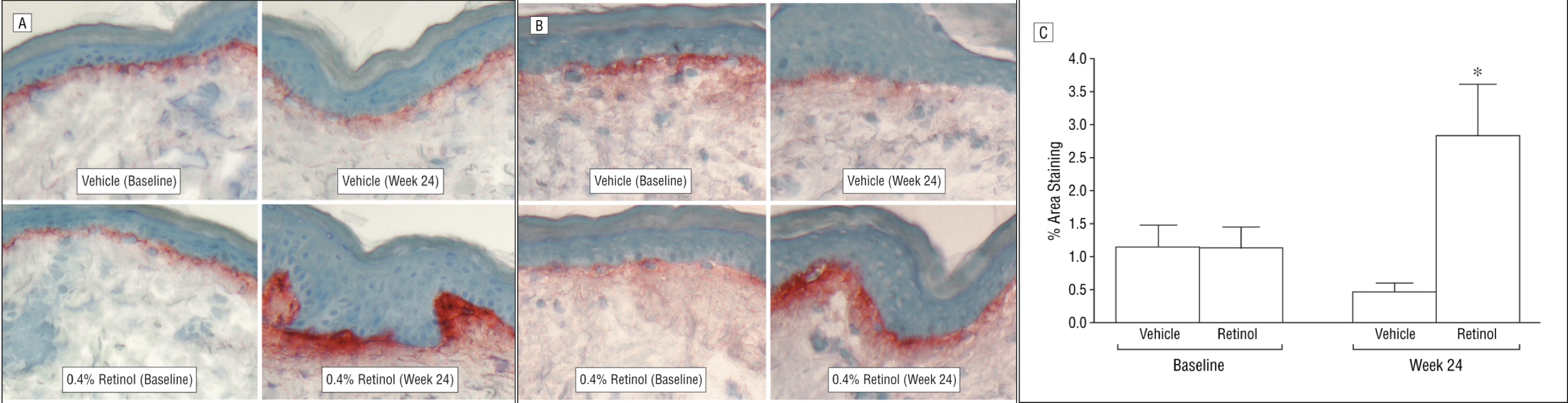
Topical retinol induces type I procollagen protein in chronologically aged skin. Baseline and 24 weeks after retinol- or vehicle-treated skin was analyzed for type I procollagen by immunohistologic analysis (SP1 staining [reddish-brown color represents immunostaining], original magnification ×20). Panels A and B are from 2 representative subjects. Panel C summarizes quantitation (percentage of the dermis stained by SP1) of procollagen type I immunostaining (n = 4). Error bars indicate standard error. *P = .049 for retinol vs control in the difference of percentage of area staining from baseline to week 24.
Regulate follicular keratinization, control oil and remove acne: Unclog the keratotic plugs at the follicular openings, reduce the formation of blackheads and closed comedones, and reduce the probability of pore clogging from the source. Inhibit the excessive secretion of sebum by sebaceous glands, and have a clear auxiliary improvement effect on mild to moderate inflammatory acne.
Inhibit melanin, even and brighten skin tone: Down-regulate tyrosinase activity, reduce the excessive synthesis of melanocytes, and fade sun spots, acne marks and post-inflammatory pigmentation. Accelerate the shedding of melanin-carrying aged keratinocytes, making the overall skin tone more translucent and even.
Long-term optimization of skin barrier function: Low-concentration and regular use can up-regulate the expression of filaggrin, promote the normal differentiation of the stratum corneum, and improve the skin's water-locking ability. Note: High concentration or intolerance stage will temporarily weaken the barrier, resulting in dryness, redness and peeling.
Core Formula Difficulties and Solutions
The biggest formula pain point of retinol is oxidation and photodegradation: the conjugated double bonds are rapidly broken by light, heat and oxygen, the activity attenuates, and irritating by-products such as retinol peroxides are produced.
Core Hazards of Degradation Process
Rapid activity attenuation: Without stabilization treatment, the degradation rate of retinol can exceed 90% after 72 hours of UV irradiation, and the actual efficacy of the formula is far lower than the labeled addition amount.
Generation of irritating by-products: Light/oxygen-induced double bond cleavage will generate retinol peroxides, epoxides, various isomerization products. These impurities will directly irritate the skin and aggravate redness, stinging and inflammatory reactions.
Amplified phototoxicity risk: A large number of free radicals are released during the degradation process, which will instead weaken the skin barrier, aggravate the photoaging risk and go against the original intention of anti-aging.
Mainstream Formula Stabilization Solutions
Molecular inclusion/microcapsule encapsulation technology: Use the hydrophobic inner cavity of β-cyclodextrin to encapsulate retinol, isolate the interference of external light and oxygen, and control the degradation rate within 15% after 72 hours of UV irradiation. Multi-layer microcapsules and burst-bead dosage forms can realize slow release of active ingredients, lock activity during storage, and slowly release after application on the skin, while reducing immediate irritation.
Antioxidant system compounding: Add natural mixed tocopherols, BHT and other oil-soluble antioxidants to directly block the oxidation chain reaction, which is the most classic and effective means to improve retinol stability. Avoid adding a large amount of water to prevent hydrolysis from accelerating the loss of activity.
Derivative substitution and compatibility optimization: Partially replace pure retinol with more stable derivatives such as retinyl palmitate and HPR to reduce the degradation rate while taking into account mildness. Combine with 0.01-0.1% pentapeptide-1, which can not only up-regulate filaggrin, promote ceramide synthesis to reduce irritation, but also synergistically enhance RAR receptor activity to achieve the "stability and efficacy double improvement" effect.
Packaging and process control: Use opaque and light-proof packaging, produce at low temperature and fill in the dark throughout the process, and avoid high temperature (>60℃) destroying the encapsulation structure and molecular activity.
Product Development Ideas and Selection Suggestions
1. How to Choose Different Dosage Forms
Anhydrous essence / oil-based essence: No free water in the system, greatly reducing the oxidation risk, with the best stability; the disadvantage is that the skin feel is relatively oily, suitable for dry skin.
Single-dose ampoule: Single independent sealed packaging, isolated from oxygen, opened and used each time, solving the storage oxidation problem; suitable for adding free retinol, which is a popular retinol dosage form at present.
Cream system: Water-oil emulsification system, with medium formula difficulty, must be matched with a stable system + antioxidants; suitable for daily anti-aging creams, the concentration is recommended to be relatively low.
Lyophilized dosage form (lyophilized tablet / lyophilized mask): The active substance is separated from the water phase, and the lyophilized solid form isolates moisture. It is re-dissolved before use to maximize the protection of retinol activity, suitable for high-activity formulas.
Water-based system: The formula has the highest difficulty. Free retinol is not recommended to be directly added to the water phase; encapsulated retinol raw materials are preferred.
R&D tip: Retinol products are recommended to be equipped with daytime sun protection guidelines. Retinol itself is not photosensitive, but the accelerated skin keratin metabolism makes ultraviolet rays more likely to cause damage, so it is necessary to do a good job of sun protection synchronously.
2. Recommended Addition Amount
The retinol irritation reaction (redness, dryness, peeling, stinging) is commonly known as the "vitamin A adaptation period", which originates from the regulation of keratinocytes, not the toxicity of raw materials.
Reference for safe cosmetic use concentration: According to the SCCS opinion of the European Union, the upper limit of retinol equivalent for leave-on facial products is 0.3%, and that for body lotion is 0.05% (retinol, retinyl acetate, retinyl palmitate are uniformly converted to retinol equivalent). The formula can refer to the following systems:
① Activity locking system
Add 0.1%-0.5% mixed tocopherol + 0.05%-0.1% BHT to the oil phase to block the oxidation chain reaction, and the activity retention rate after 72 hours of UV irradiation can be increased from less than 10% to 85%.
Compound 0.02%-0.05% EDTA disodium as a chelating agent to isolate the catalytic degradation of retinol conjugated double bonds by metal ions such as Fe³⁺ and Cu²⁺.
Prioritize the use of β-cyclodextrin inclusion/liposome microcapsule encapsulation technology to lock retinol molecules in the hydrophobic inner cavity, isolate the interference of water phase, light and oxygen, and realize slow release on the skin surface, greatly reducing immediate irritation.
② Mild tolerance system
Control the retinol addition amount in the range of 0.1%-0.3%, and match 2%-5% ceramide + sodium hyaluronate to strengthen the skin barrier and reduce dryness and peeling.
Compound 0.5%-2% centella asiatica extract + allantoin to down-regulate the release of inflammatory factors and avoid redness and stinging caused by high-concentration retinol.
Can be combined with 2%-3% niacinamide, which not only accelerates the transformation of retinol to retinoic acid to improve efficacy, but also inhibits the overexpression of AQP3, further relieves skin dryness, and achieves synergistic whitening and oil control.
Forbidden Compatibility Red Line
Absolutely forbidden to compound with high-concentration fruit acid, salicylic acid and pure vitamin C. The low pH environment will directly destroy the retinol structure, and superimpose the keratin exfoliation effect, which is easy to cause severe irritation.
The alcohol addition amount in the formula should not exceed 5%. High-concentration alcohol will aggravate the water loss of the skin barrier and greatly reduce the user's tolerance.
Crowd tip: Pregnant women are not recommended to use retinol-containing skin care products; sensitive skin needs to gradually build tolerance from low frequency and low concentration.
Safety and Regulations
1. Safety Assessment
CIR assessment: Retinol is safe for use in cosmetics, with concentration ≤1% (facial) and ≤0.05% (body).
Teratogenicity: High oral dose has teratogenic risk, and the external absorption is extremely low, but pregnant women are advised to use it with caution.
Phototoxicity: No phototoxicity, but sun protection needs to be strengthened during use.
2. Global Regulations
China: Strictly managed in the "Technical Specification for Cosmetic Safety (2022 Edition)". Leave-on products: 1%; rinse-off products: the upper limit of concentration can be appropriately relaxed. Label requirements: The warning "Use with caution for pregnant women" must be marked in a prominent position on the package, and it is forbidden to add it to products for infants and young children aged 0-3.
European Union: Implemented in accordance with EU Regulation 2024/996. Leave-on products: 0.3% (facial); rinse-off products: 0.05%. Non-compliant products are not allowed to be put on the market from November 1, 2025, and the sale of non-compliant products will be completely banned in the EU market from May 1, 2027. Label requirements: All retinol-containing products must be marked with "Contains vitamin A-related compounds that contribute to the daily vitamin A intake".
United States: Implemented under the framework of the "Modernization of Cosmetics Regulation Act (MoCRA)". Leave-on products: no clear upper limit; rinse-off products: no clear upper limit (0.3%, 0.5%, 1% retinol are common in the market). The claim determines the product attribute: cosmetics only improve the appearance (improve the appearance of fine lines); if it claims to treat wrinkles, repair skin structure, treat acne → it belongs to drugs and requires FDA new drug approval.
Japan: Leave-on products: no clear upper limit; rinse-off products: no clear upper limit. Label requirements: If it claims anti-aging, improving fine lines and other effects, it needs to complete the approval of the Ministry of Health, Labour and Welfare as a quasi-drug, and submit the corresponding human efficacy verification data. Implement the full ingredient descending listing system, retinol must be clearly marked in the ingredient list, and fuzzy codes are not allowed.
Summary
As an "evergreen tree" of skin care active ingredients, retinol has few rivals in the cosmetic industry in terms of sufficient scientific evidence and comprehensive efficacy. From the optimization of synthetic process at the raw material end, to the stabilization and sustained-release technology at the formula end, to the concentration gradient and compounding strategy at the application end, the technological evolution of retinol has never stopped.
The future trend of retinol will focus on: new delivery carriers, compounding barrier repair ingredients, and development of mild retinol derivatives.
For brands, mastering the full-chain knowledge of retinol "raw material - formula - efficacy - safety" is the key to building core competitiveness in the anti-aging track.
Check the product link:Retinol
References
[1] Pawelczyk A, Palczewska G, Palczewski K. Retinoids: active molecules influencing skin structure formation in cosmetic and dermatological treatments[J]. Postepy Dermatol Alergol, 2019, 36(5):561-567. https://pmc.ncbi.nlm.nih.gov/articles/PMC6791161/
[2] Kafi R, Kwak HS, Schumacher WE, et al. Improvement of naturally aged skin with vitamin A (retinol)[J]. Arch Dermatol, 2007,143(5):606-612.
[3] SCCS. Opinion on Vitamin A (Retinol, Retinyl Acetate, Retinyl Palmitate). 24 October 2022. https://health.ec.europa.eu/system/files/2023-01/rtp_032017.pdf
[4] Kang S, Duell EA, Fisher GJ, et al. Application of retinol to human skin in vivo induces epidermal hyperplasia and cellular retinoid binding proteins characteristic of retinoic acid but without measurable retinoic acid levels or irritation[J]. J Invest Dermatol,1995,105(4):549-556.
[5] Zielińska A, Nowak I, Grąbczewska J, et al. Solid lipid nanoparticles incorporated with retinol and pentapeptide-18—optimization, characterization, and cosmetic application[J]. Int J Nanomedicine, 2024,19:1887-1902. https://pmc.ncbi.nlm.nih.gov/articles/PMC11432460/
[6] European Commission. Commission Regulation (EU) 2024/996 of 3 April 2024 amending Regulation (EC) No 1223/2009. https://eur-lex.europa.eu/legal-content/EN/TXT/HTML/?uri=OJ:L_202400996
[7] FDA. MoCRA (Modernization of Cosmetics Regulation Act of 2022)
[8] NMPA. 《已使用化妆品原料目录(2021 版)》