
Nine out of ten customers who ask about Pro-Xylane start with concentration. But what "30%" actually means is a question few can answer. That one missing distinction can be the difference between a fair price and an overcharge.
Someone asked me again the other day: "What concentration is your Pro-Xylane?"
I hear this a few times a week. Usually I ask back: "Do you mean the solution concentration, or the pure active concentration?" More often than not, that's where the conversation stalls.
I don't blame them. On packaging, "30% Pro-Xylane" is printed far bigger than the brand name itself. The words "Pro-Xylane solution" sit in tiny print in a corner. Most people only see the big number. So let's clear this up properly.
What Pro-Xylane actually does
First, the basics. Pro-Xylane's INCI name is hydroxypropyl tetrahydropyrantriol, CAS number 439685-79-7. L'Oréal first developed it from beechwood xylose. It's listed in China's Inventory of Existing Cosmetic Ingredients (2021 Edition), so there's no issue using it in skincare.
It works differently from the usual anti-aging actives. Acids exfoliate the epidermis. Oils seal the surface with a film. Pro-Xylane does neither. Once it's in the skin, it's more like passing a note to the fibroblasts, telling them to step up and make two things.
One is glycosaminoglycans, GAGs for short. In the dermis they're a bit like a sponge, holding water and propping up the spaces between cells. As we age, they decline, and the face starts to look dry and hollow.
The other is collagen — the steel reinforcement of the dermis, the thing that controls firmness.
Put simply, Pro-Xylane gets the skin to rebuild its own support structure. That's why it has a gentle temperament. It isn't aggressive, but it's steady.
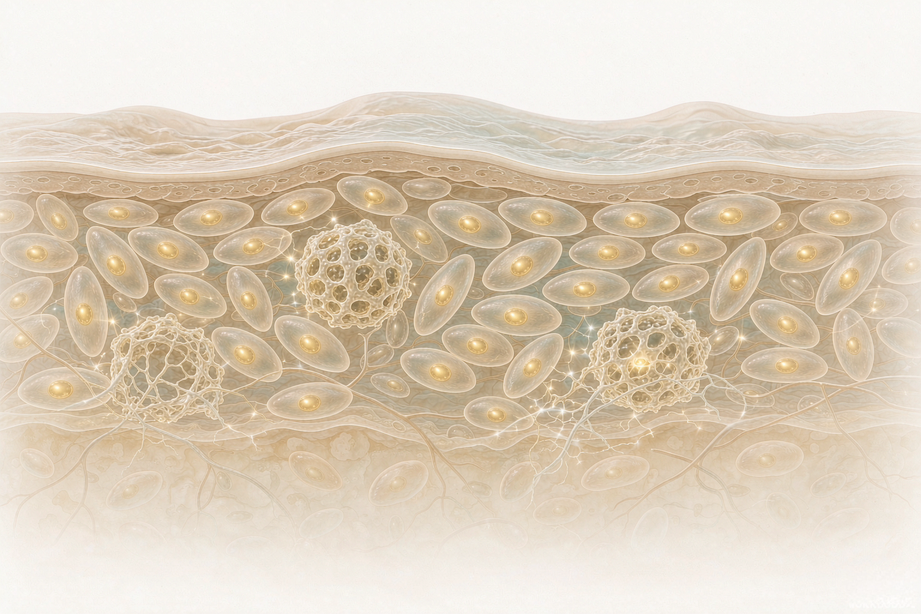
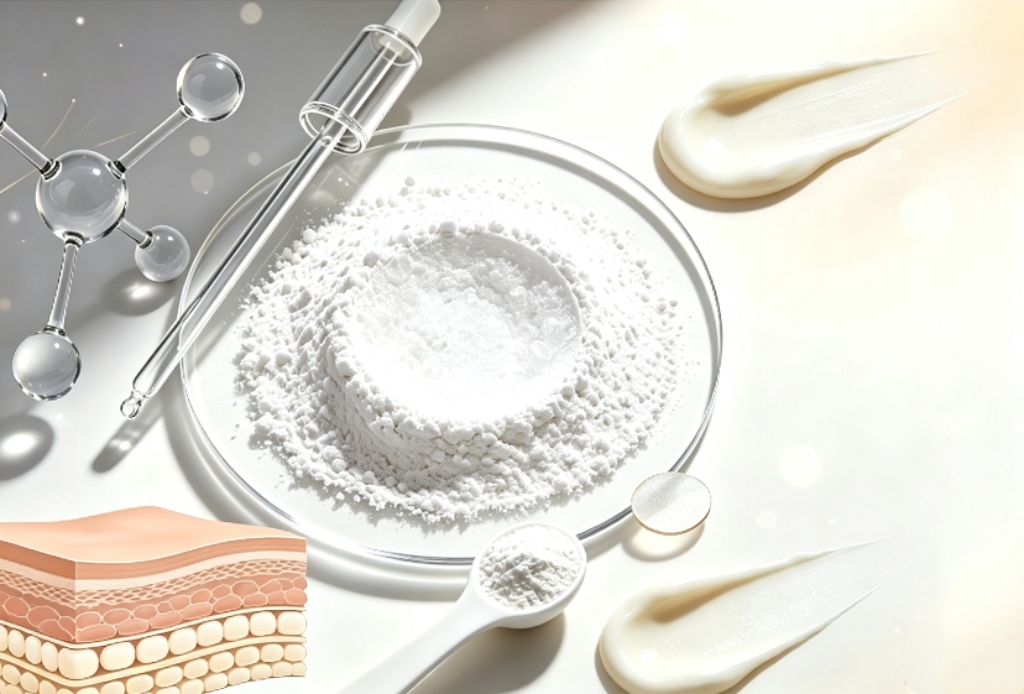
Illustration: Pro-Xylane acts on the dermis, stimulating new glycosaminoglycans and collagen fibers
What it's good for, and what not to oversell
Based on the projects we've worked on, plus published literature, Pro-Xylane suits a handful of situations.
One is prevention from around age twenty-five, when collagen starts to decline. Using it then can hold onto fullness and firmness a bit longer.
Another is when support is failing — cheeks starting to sag, the jawline getting softer, the apple of the cheek flattening. These are problems it can address.
The plumping effect from increased GAGs counts too. The face looks a bit fuller, which reads as younger.
But it's genuinely not a cure-all. Deep wrinkles that are already there? That's aesthetic medicine territory. Dark spots and dullness aren't its job either. If you call it "long-term maintenance and keeping skin in good shape," I'm fine with that. "Overnight transformation" — anyone who writes that knows it's not true.
That matters especially when you're developing a product. Overstep on claims and you'll be dealing with filing reviews and marketing compliance later.
On concentration, don't get tangled up in the numbers
This is where the debate is loudest, and where the most manipulation happens.
Here's the thing to nail down first: "30% Pro-Xylane" on a label refers to how much Pro-Xylane solution is in the formula, not the pure active concentration. Two different things.
The math isn't complicated: pure Pro-Xylane concentration in the finished product = amount of solution added × active content of that solution. Mainstream Pro-Xylane solutions on the market run at roughly 35% active content. Do the math, and 30% solution added comes out to just over 10% pure dry active.
So where does that number sit?
Pure dry active at 3% is the baseline effective threshold — you can see a rise in glycosaminoglycans, and many entry-level products start there.
The 5% to 10.5% range is comfortable, covering both efficacy and safety. China's Inventory of Existing Cosmetic Ingredients lists 10.5% pure dry active as the highest historical safe use level for leave-on products. Above that, you need a third-party safety assessment.
Go higher still, and both the process and the safety profile need recalculating. More is not automatically better.
So the question to ask is "what's the pure active concentration," not just "what's the concentration." Without that number, every comparison afterwards is people talking past each other.
When we put together a proposal for a client, we write in all three figures: pure active, solution, and active content. Saves arguing later.
Concentration alone isn't enough
Concentration is one variable, but it's not the whole story.
The formula has to hold it up. Pro-Xylane is water-soluble, so it goes into the water phase. A pH between 4.5 and 7.5 is fine. In production, add it during the cool-down stage, keeping the temperature under 40–60°C. If the process isn't right, the active degrades, and a high number on the label means nothing.
What you pair it with matters too. With ceramides and panthenol, it supports anti-aging while looking after the barrier. With low-concentration peptides, you're hitting multiple pathways. With hyaluronic acid, hydration and plumping work together. On the other hand, high-concentration acids or high-strength pure vitamin C need careful compatibility checks, or separate use times.
The format matters as well. Serums, creams, eye creams and masks — leave-on formats — are the right fit. Rinse-off products offer limited benefit and generally aren't worth making.
One more thing that's easy to miss. Pro-Xylane is slow. Results usually take eight to twelve weeks. Tell marketing that upfront, or the product will be two months old when the "it doesn't work" complaints start arriving.
If you're launching a Pro-Xylane product, go in this order
Say you're evaluating a Pro-Xylane ingredient, or getting a product ready. Here's a sequence that works.
First, ask about pure active concentration, not the solution number. Have the supplier put the active content and the conversion method in the technical documents. If they're vague, there's no point continuing.
Second, look at your audience. For prevention around twenty-five, starting at 3% is enough. For mature skin with visible laxity, 5% to 10.5% is a better fit.
Third, check the paperwork. Can they provide COA, MSDS and TDS by batch? Can samples be arranged quickly? These look like small things, but they're usually what holds up a timeline.
Fourth, look at pairing. Pro-Xylane on its own is fine, but combining it with a repair product usually makes more sense. A healthy barrier means better absorption downstream — not a complicated idea.
Pro-Xylane paired with ceramides is a common anti-aging plus barrier-repair approach
At the end of the day
Pro-Xylane has been hyped a bit over the past couple of years. It also has real substance — no need to deny that. It isn't magic, though. That needs saying too.
Get the concentration right, get the formula right, give it enough time, and it will pay you back gradually. For anyone making products, explaining that logic to consumers is more useful than printing a few more percentages on the pack.
As a raw material supplier, there are only a few things we can promise: clear specs, complete documentation, and samples before you talk volume. What the goods actually are should be transparent from the first email onward.
View the product: Pro-Xylane (Hydroxypropyl Tetrahydropyrantriol) |Ceramide (NP AP EOP NS)
Further reading: Pro-Xylane: A Comprehensive Guide to Mechanism of Action, Comparison with Retinol and Peptides, Regulatory Standards, and Formulation Considerations| Cosmetic Ingredient Compliance: EU CosIng & China IECIC Lookup Guide
References
National Medical Products Administration. Inventory of Existing Cosmetic Ingredients in China (2021 Edition), filing data for hydroxypropyl tetrahydropyrantriol.
Sok J, Pineau N, Dalko-Csiba M, et al. Improvement of the dermal epidermal junction in human reconstructed skin by a new C-xylopyranoside derivative. European Journal of Dermatology, 2008, 18(3): 297-302.
Pineau N, et al. A new C-xylopyranoside derivative induces skin expression of glycosaminoglycans and heparan sulphate proteoglycans. European Journal of Dermatology, 2008, 18(1): 36-40.